The Future of Blockchain 👾
I interviewed Sefy Tofan, an innovator and entrepreneur in the Web3.0 space, as part of a series of interviews with key figures in the tech industry. This article will focus on blockchain, or Web3, or perhaps Bitcoin? From the very first sentence of the interview, I realized that this is a broad, vast, and very unclear subject, and that we are only at the beginning of a revolution.
What Does Web3.0 Mean? #
From a practical perspective:
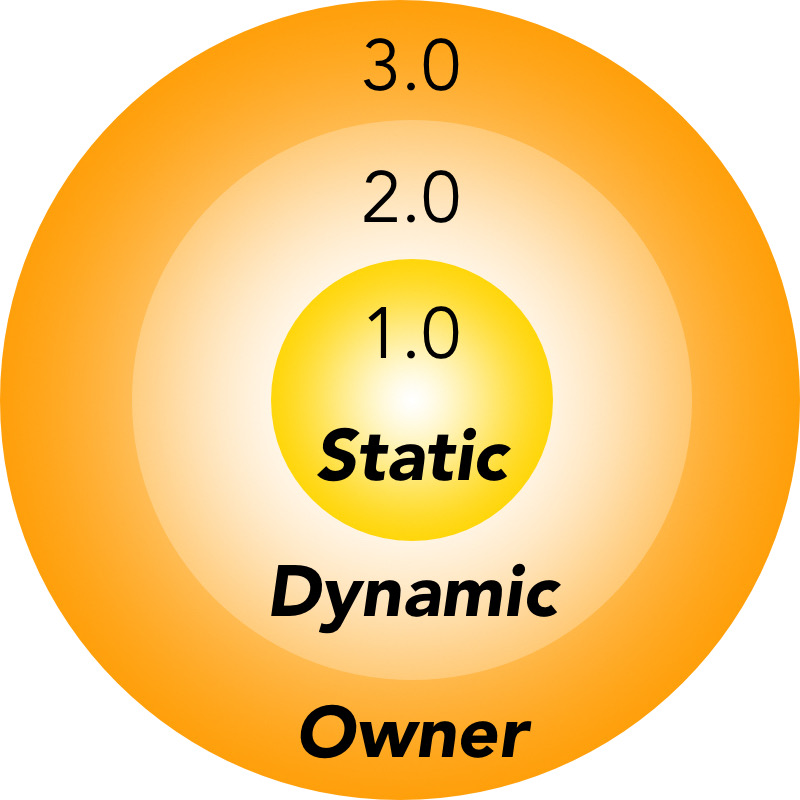
- Web 1.0 - Static websites - The user as a consumer, for example, newspapers.
- Web 2.0 - Dynamic websites - The user as a consumer and content creator, for example, social networks.
- Web 3.0 - User ownership - The user as a consumer, content creator, and owner, for example, NFTs.
Sefy explains that a shift in how we perceive the human experience is taking place in the digital space: increasing the amount of information reaching our senses through virtual coordination that aligns with us and creates a connection to the human world.
Why Hasn’t This Technology Replaced Banks Yet? #
Many people today tend to think of money as something tangible, perhaps because of banknotes and coins. Sefy predicts that banks will change their way of thinking, and money will no longer be tangible at all, existing only in the virtual space.
We are seeing the first signs of this in currencies such as Bitcoin, but there are reservations about introducing decentralization technology into the global economy. Banks’ financial model today is based on systems of debt: banks effectively lend money they do not have, so they have no incentive to make the transition to virtual currencies that are not fully under their control. Debt is what drives the economy. Sefy emphasizes that the principle of debt is not part of blockchain, creating a fundamental clash between the principles underlying the global economy and those underlying blockchain.
Ray Dalio, an American investor and author, has spent his life working in investing and economics. According to his research, recurring cycles can be found across hundreds of years of global economic history. Each time, following a large-scale war, the victors dictated a “world order of nations.” The currency of the country at the top of that order becomes the new global currency, the World Reserve Currency. Sefy raises a question: if the global currency were decentralized and not controlled by a single country, the nature and behavior of the international economy as it has existed for hundreds of years would change in ways we cannot predict today.
In Web3.0, Do All Assets Have to Be On-Chain? #
Sefy first explained the structure of blockchain:
- Layer 1 - The base layer, where the principle of agreement (consensus) is established and information about a limited number of transactions is recorded (around 10 per second for Bitcoin, for example).
- Layer 2 - A layer that enables efficiency: thousands of transactions per second, at a significantly lower cost. This layer relies on the base layer, which might, for example, store a summary after thousands of transactions.
There is a direct relationship between the size of L2 and the number of transactions that can be performed. We can also reduce the cost of each transaction (gas fees). However, an increase in the number of transactions may lead to a decrease in network security, something known as the Scalability Trilemma: the ability to achieve only two of three desirable properties: security, decentralization, and transaction capacity.
There is a lot of investment in this field, but there is still no “winning” technology for storing large amounts of information on-chain the way large companies currently do on their servers.
I was surprised to discover that there is no end-to-end blockchain-based SaaS. In practice, Web 3.0 applications run not only on-chain, but also on technologies from the Web 2.0 world. Web 3.0 handles authentication and payments, while Web 2.0 stores the information in a centralized location.
What Needs to Happen Before We Can Start Using This Technology in Everyday Life? #
- Adaptation - Adapting this technology to users’ needs. Integrating it into our everyday hardware, phones, checkout systems, and everyday conversation. The arrival of tech giants could help.
- Regulation - There is currently no clear regulation in this field, so large organizations and individuals are concerned about taxes that might be introduced and procedures that are unclear or undefined.
- Security and authentication - There is a fundamental need to streamline the steps involved in making a purchase, from transferring funds from a bank account to a digital wallet through to the purchase itself.
- Transaction confirmation time - A block contains a set of transactions. Once the block has been “mined,” the transactions are either confirmed or not. Each block takes time to be mined by the network.
- User experience - As things stand, if we want to use cryptocurrency, we need to transfer it to a virtual wallet, go through an authentication process, connect with the virtual wallet, complete several additional steps to approve the transaction, and then wait a few minutes to make sure it has been confirmed. The blockchain user experience feels like a kind of “punishment,” unlike using a regular credit card, which is very familiar and straightforward.
Sefy concludes by saying that the entire blockchain experience does not necessarily have to resemble our current understanding of money. About a year ago, Sefy launched a game with a blockchain-based economy. He says the vision is to bring together gaming, blockchain, and the real world. We will get there through further breakthroughs, but there is no knowing how.